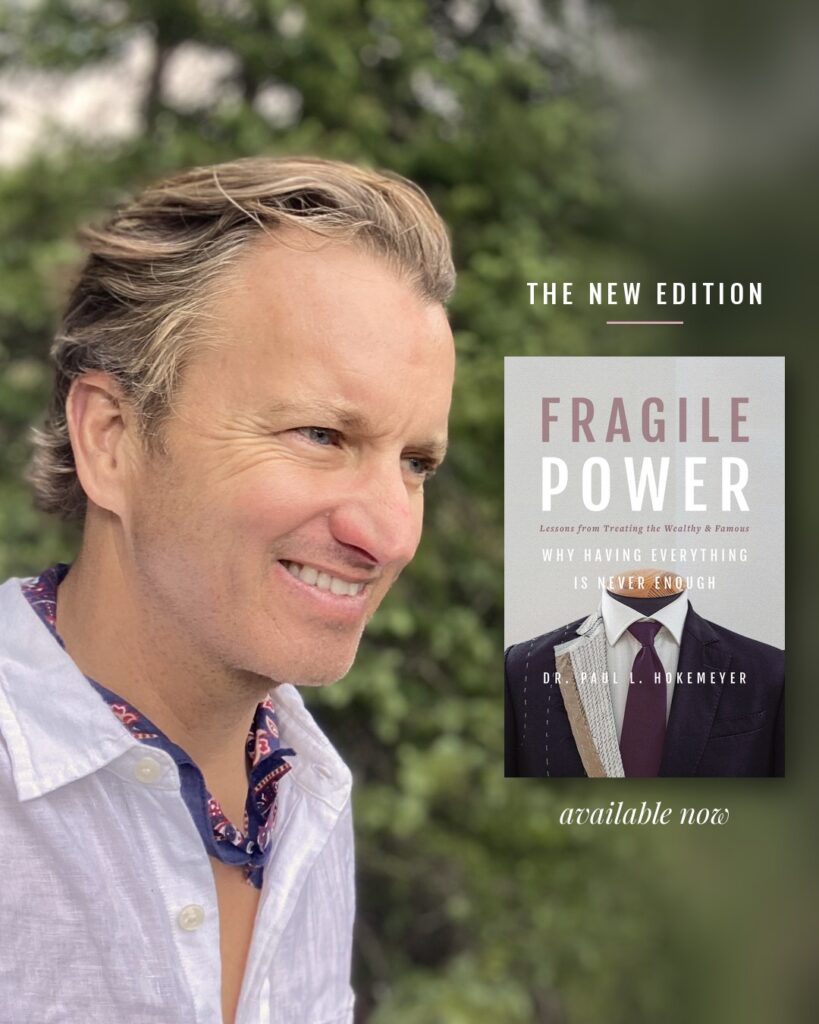
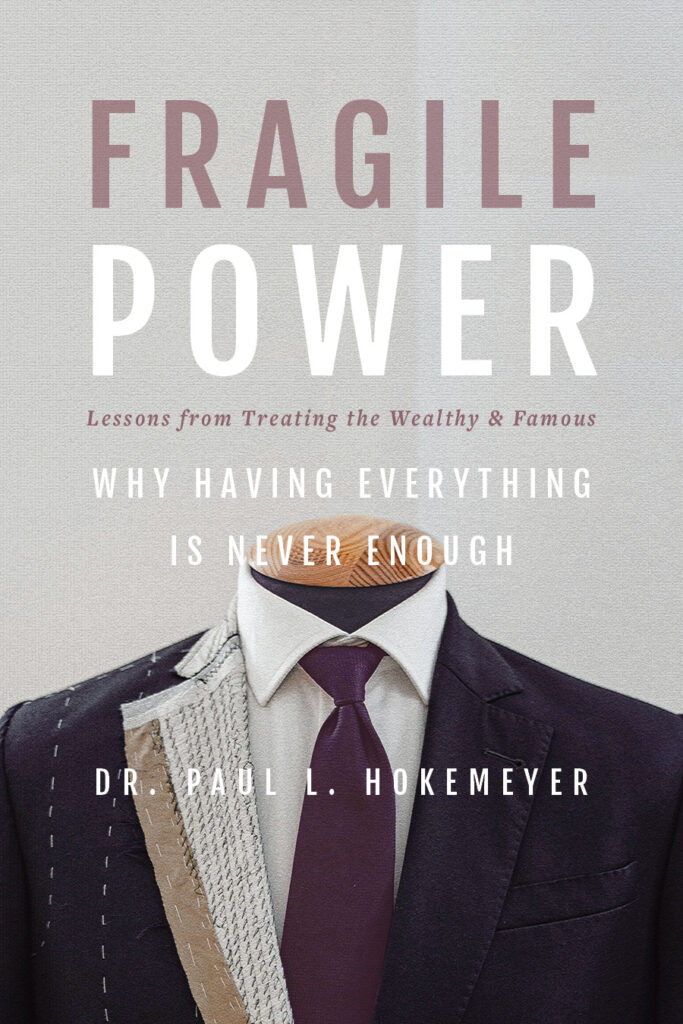
New edition, with a new introduction and epilogue
Lessons from Treating the Wealthy & Famous
What happens when the life everyone envies betrays you?
For nearly two decades, Dr. Paul Hokemeyer has sat with people the rest of the world only reads about. These are people whose names, fortunes, and achievements put them beyond public understanding. In the privacy of his consulting room, he has personally witnessed what wealth hides: addiction and despair, marriages strained by infidelity and dependency, adult children caught between independence and financial reliance, and families where money simultaneously expresses love and enforces control.
His book, Fragile Power, is about what he learned there.
Neither exposé nor indictment, it’s a clinically grounded, deeply humane challenge to one of our culture’s most durable assumptions: that money guarantees happiness, freedom, power, and control.
As Dr. Hokemeyer shows, wealth doesn’t spare people from mental health and relational struggles. It often makes them harder to see, harder to name, and harder to treat.
A defining voice on wealth and mental health
When the book first appeared, its central claim was a little heretical.
In it, Dr. Paul maintained that wealth is not only a financial condition but a distinct cultural identity. It shapes how a person loves, whom they trust, and how they suffer. Like every other identity, it deserves cultural humility and clinical skill in providing mental health and addiction treatment services.
Guidance for clinicians and advisors
The same advantages that make wealth enviable can make treatment harder. In the consulting room, privacy can turn into secrecy. Resources can shield dysfunction from consequence. And emotional dependence becomes hard to tell apart from financial dependence. As a result, the clients who seem to need help the least are often the least well helped.
Fragile Power gives therapists, physicians, addiction professionals, and the advisors who serve families of wealth a clearer framework for this work. It covers how families organize themselves around a troubled child and how sex becomes entangled with power. It explains why narcissistic traits appear more often in lives of great privilege, and why treatment programs built for affluent patients so often miss what those patients need.
For the woman beside the man the world admires
Some of the loneliest people in these pages are not the famous ones. They are the people married to them. These are women who built a life alongside a successful, admired, often charming man, and who learned over time that his need to be admired left little room for them.
If you have ever felt invisible in a life others envy, this book will feel like recognition. It names what is happening and explains why. And it points toward something better: relationships built less on performance, possession, and power than on genuine intimacy.
Some books are written. Others are raised.
Fragile Power first appeared in 2019 and now returns in a new edition. A new introduction traces the road the book has traveled since then, and a new epilogue looks toward what it is becoming. The world it re-enters tells a single story about wealth: that it wounds. This edition tells a different one. Understood honestly and held with wisdom, wealth can help heal the very fractures we fear it creates.
Kindle $12.99 · Paperback $18.99